

Report by Duncan Williams for News Advertiser newspapers
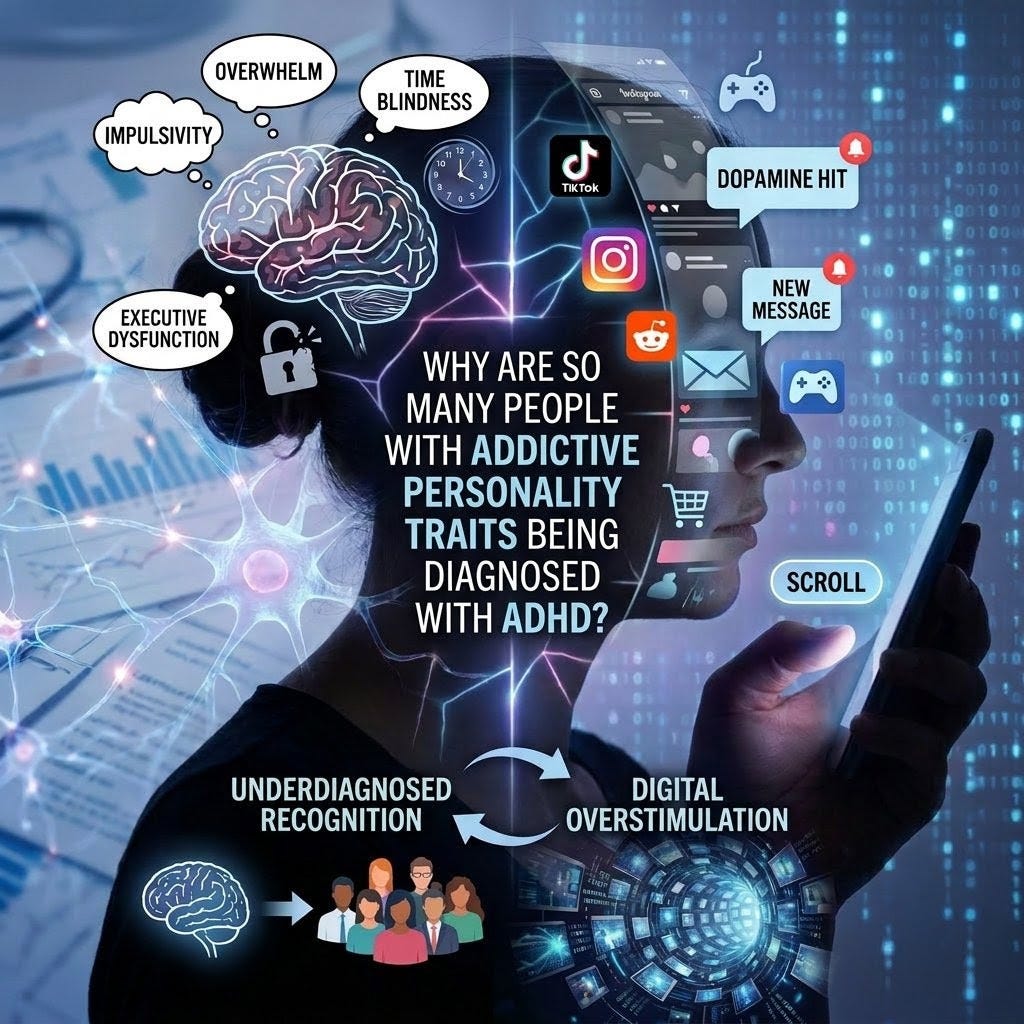
There is a growing sense that Attention Deficit Hyperactivity Disorder - ADHD - has gone from being a relatively niche medical diagnosis to a defining feature of modern life. On TikTok, Instagram and Reddit, millions of people now describe themselves as “neurodivergent”, share ADHD memes, or discuss executive dysfunction as casually as they once discussed stress or tiredness.
To some, this represents long-overdue recognition of a condition that was historically misunderstood and underdiagnosed. To others, it feels like a cultural overcorrection - a moment in which ordinary human distraction is being medicalised and amplified by the internet.
The truth is likely somewhere in between.
ADHD is real, clinically recognised, and often profoundly debilitating for those who live with it. Yet it is also true that modern digital life increasingly rewards fragmented attention, compulsive stimulation and emotional impulsivity - behaviours that closely resemble ADHD symptoms.
This is particularly relevant for people with highly addictive personality traits. Individuals who are naturally novelty-seeking, impulsive, emotionally intense or dopamine-driven are often more vulnerable to compulsive behaviours - whether that involves gambling, social media, shopping, gaming, substances or endless scrolling.
Many of these same traits also overlap with recognised ADHD symptoms.
That overlap has created an important and increasingly controversial question: are some people genuinely discovering previously undiagnosed ADHD, or are modern digital environments conditioning millions of people into patterns of behaviour that mimic it?
The uncomfortable reality may be that both things are happening simultaneously. The uncomfortable question, then, is whether society is merely discovering ADHD more effectively, or whether our technological environment is actively manufacturing ADHD-like behaviour in people who may never previously have struggled in this way.
A GENUINE RISE IN RECOGNITION
One reason ADHD appears more prevalent is simply that awareness has improved dramatically.
For decades, ADHD was stereotyped as a condition affecting hyperactive young boys who disrupted classrooms. Girls and women - who often present with inattentive rather than disruptive symptoms - were routinely overlooked. Many adults who spent years struggling with organisation, concentration, emotional regulation and chronic overwhelm were instead labelled lazy, anxious, depressed or simply incapable.
This has begun to change.
Recent data in the UK shows a sharp rise in adult ADHD diagnoses and medication use, particularly among women over 25.
Many clinicians now refer to women diagnosed in adulthood as the “lost generation” - people who would likely have been identified years earlier had diagnostic frameworks not been so male-centred.
In that sense, part of the apparent ADHD “explosion” is not an epidemic at all. It is delayed recognition.
Social media has undeniably played a role in this. For many adults, seeing others describe lifelong patterns of forgetfulness, overwhelm, sensory issues or executive dysfunction has provided the first language they have ever had for experiences they previously thought were personal failings.
And that matters.
For countless people, an ADHD diagnosis has been transformative - offering explanation, treatment and relief after decades of confusion.
THE SOCIAL MEDIA EFFECT
Yet there is another side to this phenomenon that deserves scrutiny.
Platforms such as TikTok are uniquely engineered to reward rapid emotional engagement and fragmented attention. Short videos, endless scrolling, algorithmic novelty and constant dopamine stimulation create an environment that trains the brain to seek perpetual distraction.
This matters because many ADHD symptoms - difficulty sustaining focus, impulsivity, emotional dysregulation and restlessness - are also predictable outcomes of excessive digital stimulation.
Modern technology may not “cause” ADHD in the clinical sense, but it can absolutely produce ADHD-like cognitive patterns.
A person who spends six hours a day rapidly switching between apps, notifications, videos and messages will naturally find deep concentration more difficult. Attention, like fitness, deteriorates when constantly interrupted.
In previous generations, boredom was unavoidable. Waiting in a queue, sitting on a bus or spending an evening without stimulation forced the mind to develop patience and sustained attention. Today, every idle second is filled by scrolling.
We are living through the first era in human history in which billions of people are voluntarily subjecting themselves to continuous cognitive fragmentation.
That cannot be psychologically neutral.
TIKTOK AND THE RISE OF SELF-DIAGNOSIS
Social media has also changed how people interpret themselves.
The hashtag #ADHD has generated billions of views across TikTok and Instagram, with creators presenting lists of “signs” that viewers may have ADHD: procrastination, zoning out during conversations, struggling to reply to messages, becoming obsessed with hobbies, or feeling mentally overwhelmed.
The problem is that many of these traits are not unique to ADHD. They are also common human experiences - particularly in an overstimulated, sleep-deprived and digitally addicted population.
Several recent studies have raised concerns about misinformation surrounding ADHD content online. Researchers found that many of the most-viewed ADHD videos online did not align properly with established diagnostic criteria.
This creates a powerful feedback loop.
A person who already feels distracted or overwhelmed encounters relatable ADHD content online. Algorithms then feed them more of the same material, reinforcing identification with the diagnosis. Over time, ordinary lapses in attention begin to feel clinically significant.
This does not mean people are “faking” symptoms. In many cases, the distress is genuine. But there is a difference between recognising oneself in a broad online narrative and meeting the threshold for a neurodevelopmental disorder.
The danger lies in collapsing that distinction.
ADDICTION, DOPAMINE AND THE ADHD CONNECTION
One reason ADHD diagnoses may appear especially common among people with addictive tendencies is because both are closely linked to dopamine regulation.
Dopamine is often described as the brain’s reward chemical. It plays a major role in motivation, pleasure, anticipation and attention. People with ADHD are widely believed to have differences in how dopamine systems function, which can contribute to impulsivity, novelty-seeking and difficulty sustaining focus on unstimulating tasks.
The problem is that modern technology exploits these same reward pathways.
Social media, online gambling, short-form video, pornography, gaming and app notifications all operate on variable reward systems - the same psychological mechanisms used in slot machines. Each scroll, like, message or video delivers small bursts of novelty and anticipation.
For people already predisposed towards addictive behaviour, this environment can become neurologically consuming.
Over time, constant dopamine stimulation may reduce tolerance for slower, less stimulating activities such as reading, studying, deep work or sustained conversation. The result is a population increasingly conditioned towards distraction, impatience and compulsive behaviour - traits strongly associated with ADHD.
This does not mean addiction causes ADHD in a strict medical sense. But it does mean the behavioural overlap between the two is becoming increasingly difficult to separate.
DIGITAL CULTURE REWARDS ADHD TRAITS
There is an irony at the centre of this conversation.
The same digital ecosystem that helps people discover ADHD may also be worsening the very symptoms associated with it.
Social media platforms are effectively attention extraction machines. They monetise interruption. Their business model depends on preventing sustained focus.
Notifications, autoplay, infinite scroll, algorithmic novelty and dopamine-driven engagement are not accidental design features; they are engineered behavioural hooks.
For individuals with clinically diagnosed ADHD, this environment can be particularly destructive. Research increasingly suggests that people with ADHD may be more vulnerable to compulsive internet use and manipulative digital design.
But even for people without ADHD, constant digital overstimulation can erode concentration, memory and emotional resilience.
In other words, we may be creating a society in which ADHD-like behaviour becomes increasingly normal because the environment itself encourages it.
This complicates the modern narrative considerably.
UNDERDIAGNOSIS OR OVERDIAGNOSIS?
The debate is often framed too simplistically.
Some insist ADHD has always been massively underdiagnosed and society is finally catching up. Others argue it is being wildly overdiagnosed due to social contagion and online influence.
Both positions contain elements of truth.
There is little doubt that many people - especially women and those diagnosed later in adulthood - genuinely slipped through the cracks for years. Equally, there is growing evidence that social media can encourage overidentification with psychiatric labels and blur the line between pathology and normal human struggle.
The reality is that modern life itself is becoming cognitively dysregulating.
Sleep deprivation, chronic stress, information overload, fractured work patterns and constant digital stimulation all impair attention and executive functioning. A society built around interruption will inevitably produce more people who feel unable to focus.
That does not invalidate ADHD as a legitimate disorder. But it does mean we should be cautious before interpreting every concentration problem through a purely medical lens.
THE BIGGER QUESTION
Perhaps the most important question is not “Why is everyone suddenly ADHD?” but rather:
What kind of society have we created that makes sustained attention so difficult for so many people?
Technology has given us extraordinary convenience, connection and access to information. But it has also transformed human attention into a commodity - bought, sold and manipulated by algorithms designed to keep us perpetually stimulated.
The rise in ADHD diagnoses may partly reflect improved medical understanding. But it may also be functioning as a warning signal: evidence that our environment is increasingly incompatible with deep focus, patience and mental stillness.
In that sense, the ADHD conversation is not merely about psychiatry.
It is about the cognitive consequences of modern life itself.
( Image: Pixabay Library 📸 )