

Report by Duncan Williams for Pulman's Weekly News
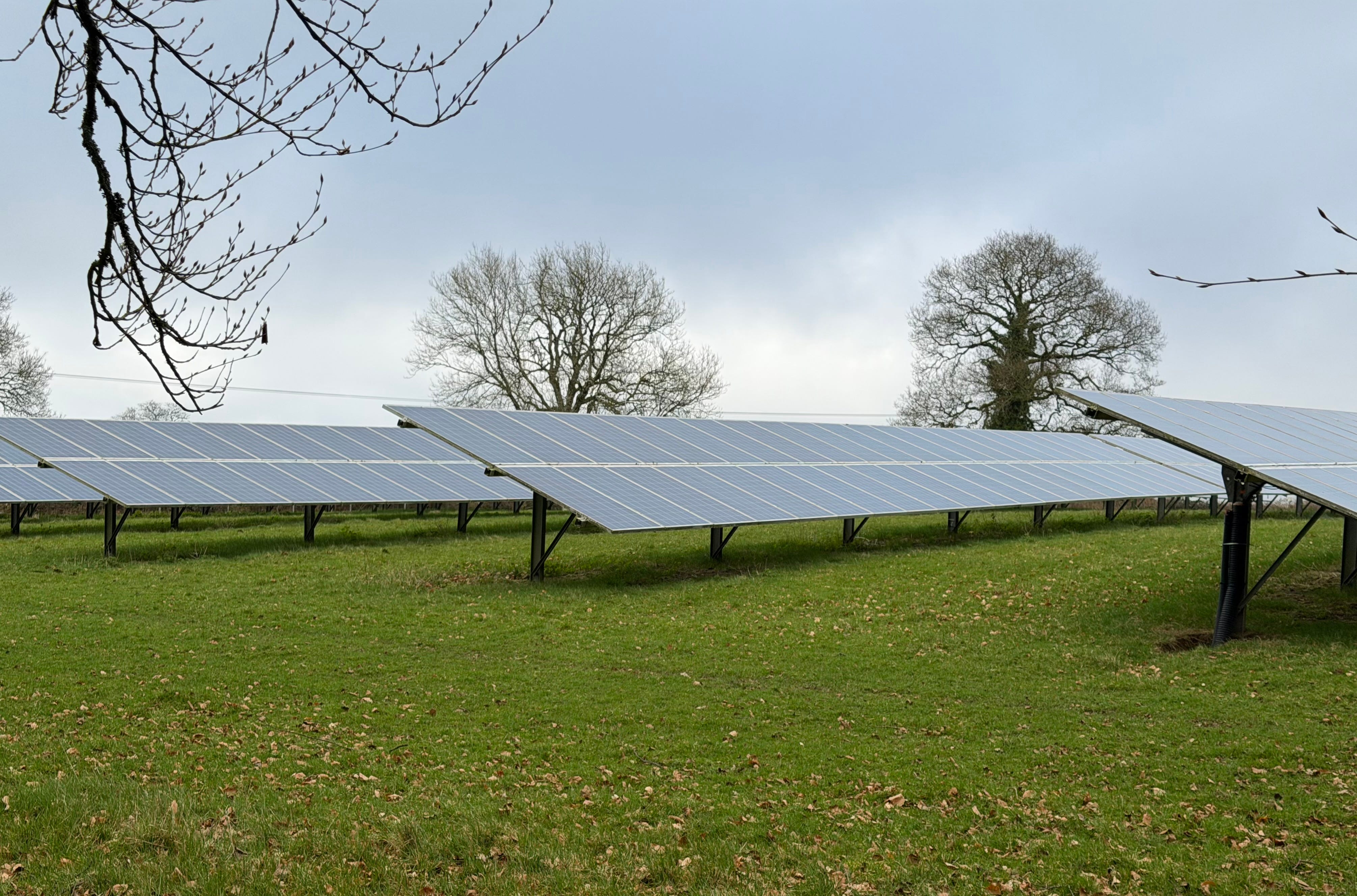
A countryside charity has warned that Devon’s farmland is under growing pressure from competing land demands, following the Government’s publication of a new national framework.
The Campaign to Protect Rural England (CPRE) in Devon has criticised the Department for Environment, Food & Rural Affairs (DEFRA) Land Use Framework, unveiled this week, arguing it could have serious consequences for food production and the county’s rural landscape.
The framework, the first of its kind in England, sets out how land could be used in future to balance priorities such as food security, renewable energy, housing and nature restoration. However, Devon CPRE says the proposals risk taking significant amounts of farmland out of production.
Steve Crowther, chairman of Devon CPRE, said the plans “confirm long-held concerns” among farming communities.
He claims around 10% of England’s land could be reassigned, including 1% for solar and wind energy and a further 9% for environmental schemes such as rewilding and habitat creation. In addition, land is expected to be allocated for housing development.
Mr Crowther questioned the Government’s assurance that enough farmland would remain to maintain current levels of domestic food production, pointing out that the UK is only around 58% self-sufficient in food.
“With a growing population and increasing global uncertainty, maintaining current levels is not enough,” he said. “We need to prioritise homegrown food production, especially in areas like Devon, which has some of the best land for livestock farming anywhere in the world.”
He also raised concerns about the expansion of large-scale solar developments on agricultural land, arguing that financial incentives are encouraging developers to prioritise energy projects over food production.
“All of our solar energy needs could be met through rooftop installations and the use of brownfield land,” he said. “But as long as it is more profitable to build on farmland, that is where developers will go.”
The charity has also warned of potential impacts on tourism, one of Devon’s key economic sectors, which depends heavily on the county’s rural scenery.
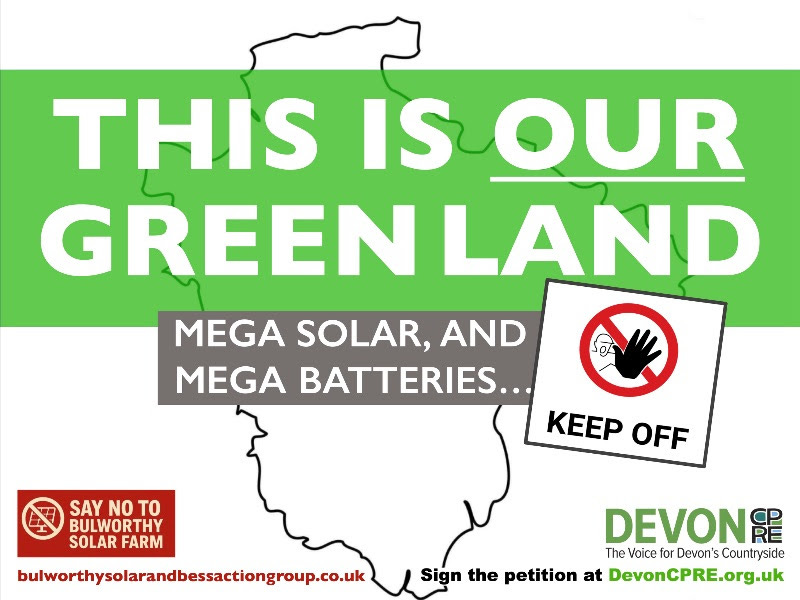
Alongside its response to the framework, Devon CPRE has launched a new campaign titled “This Is Our Green Land – Mega Solar and Mega Batteries, KEEP OFF!”, aimed at mobilising local opposition to large-scale energy developments.
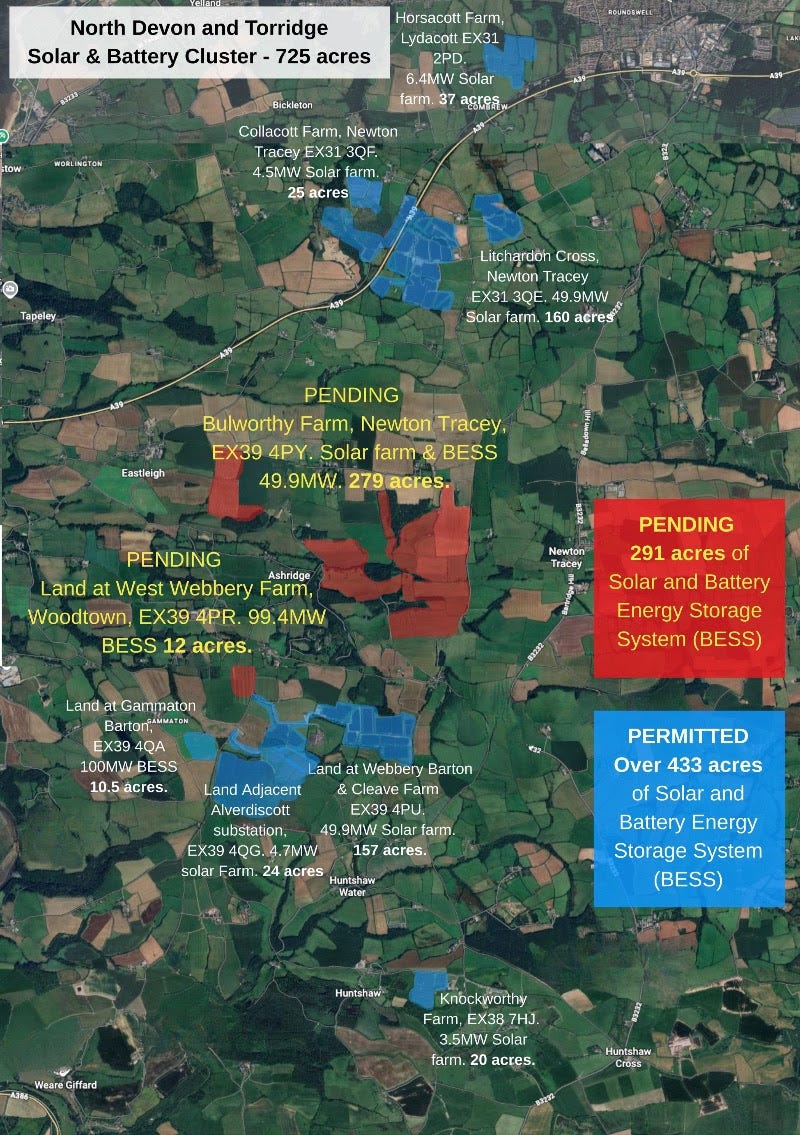
The campaign focuses on a growing cluster of solar and battery projects near the Alverdiscott grid connection point in North Devon. Six schemes have already been approved in the area, covering more than 400 acres, including one of the largest solar farms in the county at Litchardon Cross.
Two further proposals - at Bulworthy Farm and West Webbery Farm - could increase the total area to around 725 acres within an 11-square-mile zone.
Devon CPRE argues that while each application is considered individually, the cumulative impact is significant.
The campaign includes a public petition and is intended to demonstrate to both local and national politicians that residents want to protect Devon’s farmland and landscapes from what the group describes as large-scale industrial development.
DEFRA says the Land Use Framework is designed to ensure England can meet long-term challenges while balancing environmental and economic needs.
Consultation and local planning decisions will continue to play a role in how the framework is implemented.
( Images supplied by if-Media 📸 )