

Report by Duncan Williams for Pulman's Weekly News
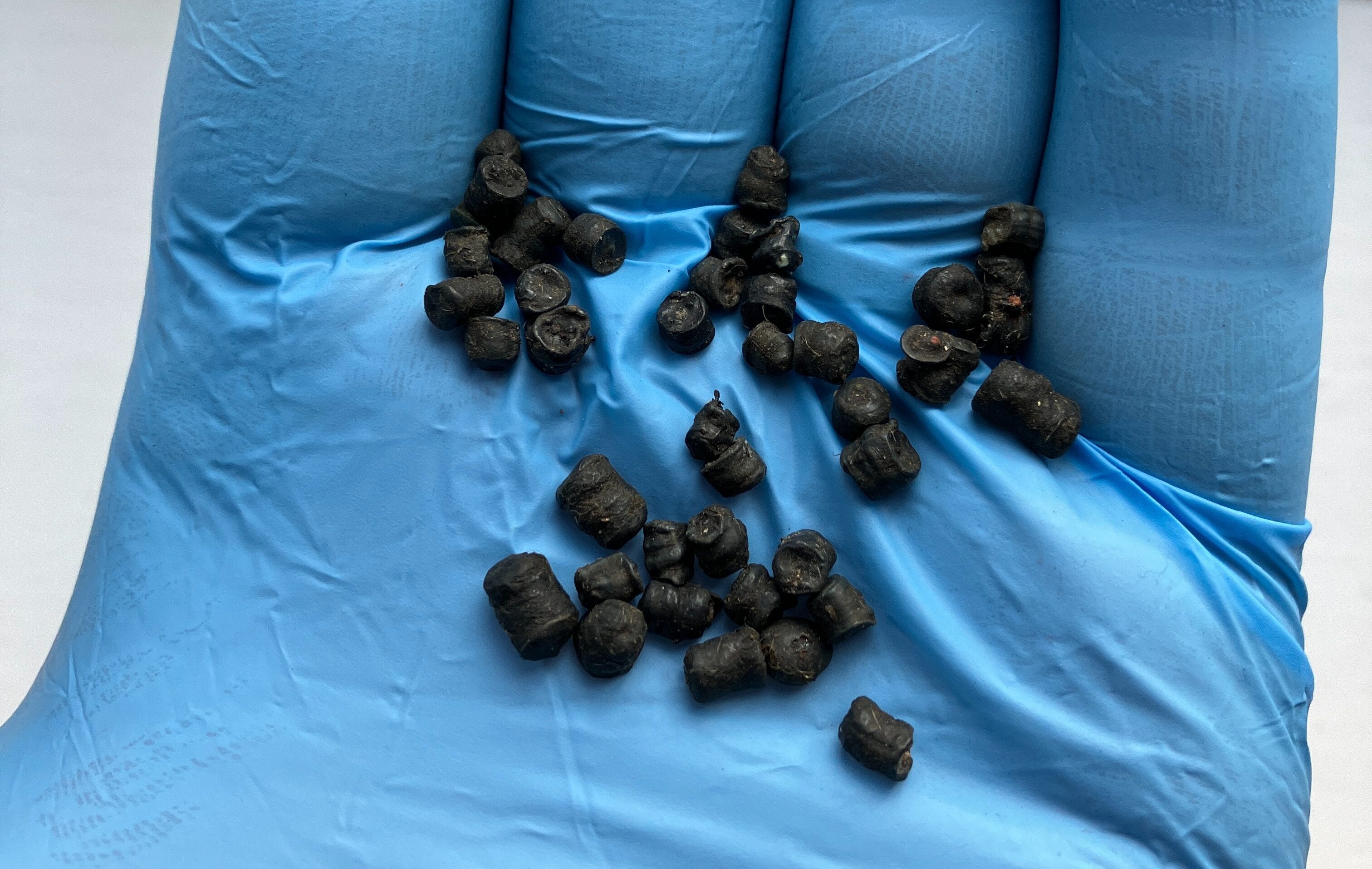
An investigation has been launched after plastic bio-beads escaped from Honiton wastewater treatment works and entered the River Otter.
Peter Williams, of Otter River Catchment Action (Orca), and a colleague spotted rafts of the small plastic beads downstream from the treatment works while installing a water quality sensor on Tuesday, 8th September.
Mr Williams said the treatment works had also been discharging untreated sewage for 17 hours at the time.
The pair filmed the outflow before contacting the Environment Agency’s pollution hotline and sending the footage to the agency.
The Environment Agency subsequently confirmed that the material was used bio-beads. A duty officer told Orca that the agency was in contact with South West Water to establish where the material had come from.
The discharge was stopped and the site cleaned up “as far as is practicable”, while an Environment Agency officer attended the site to gather evidence and establish how many beads had escaped.
South West Water confirmed the incident.
The company said: “We are aware of an incident involving the release of biobeads at our Honiton wastewater treatment works and worked quickly to stop any further release.
“Our investigation found that a small quantity of biobeads, which were being temporarily stored on site prior to being removed, entered a surface water drain during that process. Honiton wastewater treatment works does not use biobead technology as part of its treatment process.
“The material has since been cleared, and we have reviewed and updated our storage and handling procedures to help prevent a similar incident from happening again.”
South West Water said only eight of its 655 wastewater treatment works use bio-beads and that multiple containment measures are in place at those sites.
The company said bio-beads are commonly used because they provide effective treatment within a relatively small footprint. It added that secondary containment mesh has been installed at all of its wastewater treatment sites where bio-beads are used.
However, Orca has raised concerns about the potential environmental impact of the material entering the River Otter.
The group said the beads do not dissolve or readily break down and can remain in wastewater for weeks, potentially absorbing and concentrating pollutants including detergents, hydrocarbons, lead and arsenic.
Orca described the material as “an oil spill in solid form” and said the beads could remain in the environment for years. It also warned that wildlife could mistake them for food.
The group referred to research by King’s College London concerning the potential presence of metals and carcinogenic compounds associated with plastic bio-beads.
Mr Williams said he expected the Environment Agency to require skimming or vacuum containment crews to recover the material before it travelled further down the River Otter towards the coast.
He has also appealed to members of the public to look out for the beads along the riverbanks, particularly around branches and bends in the river, as well as at Budleigh beach.
Anyone finding suspected bio-beads is encouraged to collect footage or a sample using a net where it is safe to do so.
“Please email or message me with anything you find,” Mr Williams urged.
Orca has also raised wider concerns about the capacity and performance of Honiton wastewater treatment works, which it describes as the largest treatment works on the River Otter.
The group said the works was described as “approaching design capacity” in 2023 and claimed that no additional capacity had been provided despite continued housebuilding in the area.
According to figures cited by Orca, the works recorded 1,900 untreated sewage discharges during 2025, lasting a combined 2,500 hours.
The group said its own testing indicated that phosphate from Honiton almost doubled the total phosphate levels in the river during the summer and claimed this contributed to algal blooms and weed growth.
Orca also cited the East Devon District Council Water Cycle Study, saying the Honiton works was ranked second-highest in the region for wastewater vulnerability indicators.

The group claims average daily flows through the works are more than 40 per cent above the permitted limit.
It further claims that 90 per cent of untreated discharges during 2024 occurred while the works was operating below its permitted flow limit, accounting for 90 per cent of approximately 5,000 hours of sewage spills.
Orca has described these incidents as effectively unauthorised and said the equivalent figure for 2025 was 75 per cent.
The group also said telemetry data was missing for 222 days during 2024, leading to an Environment Agency compliance assessment in June 2025.
It claims annual phosphate limits continued to be breached throughout 2025.
After six years of monthly sampling, Orca said the coefficient of variance for phosphate was 116 per cent, which it described as evidence of poor process management.
The group also pointed to East Devon District Council’s decision to commit to rejecting planning applications until South West Water can demonstrate sufficient wastewater capacity, leaving 992 homes in the Local Plan in limbo.
Mr Williams explained that the latest incident should be viewed in the context of these wider concerns.
“This isn’t a one-off accident. It’s the latest evidence of the impact of under-investment in the river Otter’s major treatment works - with real consequences for the river, its wildlife, and the community around it,” he said.
The Environment Agency has previously said that bio-beads need to be properly contained at wastewater treatment works and prevented from escaping into the environment. In guidance published in December 2025, the agency said its primary concern was ensuring that bio-beads were properly managed and did not escape, adding that water companies should report any release as a pollution incident.

( Photos: EA / Unsplash 📸 )